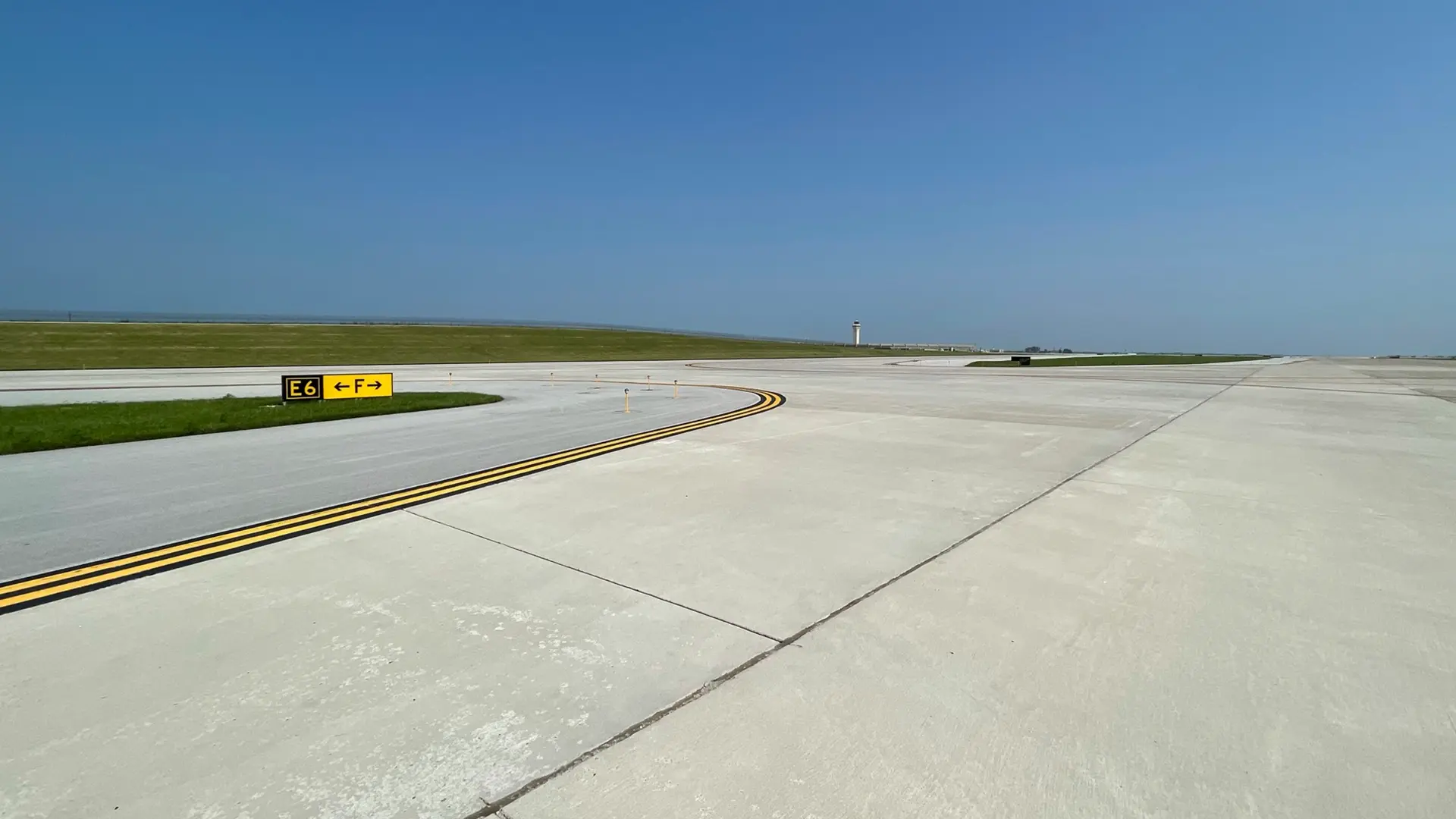
We provided airfield design and construction phase services for the rehabilitation of Taxiway F at Kansas City International Airport (MCI), the primary parallel taxiway serving Runway 1R-19L. The project included removal and replacement of 123,000 square yards of 17-inch-thick portland cement concrete (PCC), full-depth construction of a new crossover taxiway, pavement geometry modifications to meet current Federal Aviation Administration (FAA) standards, asphalt shoulder pavement rehabilitation, airfield lighting and signage improvements, earthwork, drainage improvements, and pavement markings.
The 9,500-foot-long by 75-foot-wide taxiway was experiencing widespread durability and pop-out distresses and needed significant rehabilitation or reconstruction. During the predesign stage of the adjacent Runway 1R-19L rehabilitation program, our team determined, through non-destructive testing and geotechnical investigation of existing site conditions, that the optimal way to improve the distressed taxiway would be removal and replacement of the PCC, allowing the underlying lean concrete base and other pavement layers to remain in place. This significantly reduced construction costs and shortened the construction duration.
Improving Project Outcomes
The FAA has tools and processes that, if utilized effectively, can streamline design efforts, reduce capital investment and shorten overall airfield construction duration. We developed multiple sponsor-requested Modification of Standards (MOS) submissions during design of the Taxiway F project and guided them to approval within FAA’s online Airports GIS system. The major MOS approved was a request to replace portions of the airfield pavement to match existing geometry, rather than implementing extreme changes necessary to bring the entire project up to current FAA geometry standards. Our team justified this MOS by modeling aircraft movements to show that minimum Taxiway Edge Safety Margins would be provided for the critical cargo aircraft flying into MCI. This MOS saved significant capital investment and shortened the project’s duration by several weeks.
All Airport Improvement Plan (AIP)-funded projects must be constructed to minimum FAA standards. During design production, the FAA was updating its standard construction specifications, and a new version of the advisory circular was to be released soon, providing more favorable construction specifications. Based on our team’s experience and history of effective enforcement of FAA standards, we were allowed to use the new version (10H) as the basis for the Taxiway F construction specifications. We were one of the first firms to implement the updated specifications.